
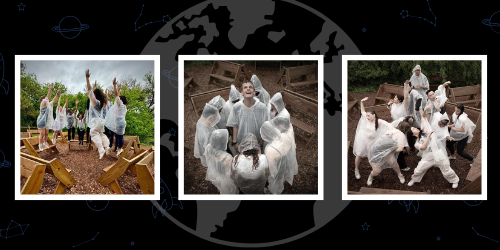
This month on Planet Classroom, audiences can watch A23a: What Are You Trying to Tell Us?, a dance-for-camera short film curated by Planet Classroom that explores climate change through movement and image.
Choreographed by Darla Johnson and filmed by the Bomar brothers’ Big Board Films, the piece translates fracture, drift, and melt into gesture and pattern—asking how climate signals move through bodies and communities.
Directed by Grant Lee Bomar with cinematography by Dean Lee Bomar, the work spans the artists’ home bases in Austin and Atlanta. Johnson’s attention to breath and silence heightens focus, inviting learners to feel climate—beyond charts—through motion, image, and sound.
The Global Search for Education is pleased to welcome Choreographer Darla Johnson and Director Grant Lee Bomar.
C. M. Rubin: What was the first visual or physical motif that made you say, “Yes—that’s A23a in human movement”? How did that image evolve once rehearsals began?
Darla Johnson: The movement for the dance emerged from the idea that A23a was caught spinning in place on a Taylor’s Column.
The dancers enter from downstage right with a backwards spiral movement, turning inward on themselves. They spiral and rise, descend and step, repeating this pattern as they move through space to create a counterclockwise Fibonacci spiral.
The movement needed breath, so I allowed myself to rise and turn inward, arcing and reaching up while circling around my center.
This movement emerged when I asked myself: what does it feel like to spin around myself? I needed the dancers to come to the center in a circle. I wanted to emulate how the penguin community takes care of their own. They take turns being in the middle of the huddle to share the warmth.
I wanted to emulate the feeling of the iceberg spinning in the water. A23a was spinning in place counterclockwise. Counterclockwise spinning symbolizes completion, death, and the return to unity, suggesting a pull back to the center, away from outward movement. The Sufis spin counterclockwise. Spiritually, I identified with the iceberg and my own life, the death of who I was, and a shift to who I am becoming.
The piece was born from a profound sensory experience. I was telling my neighbor about being caught in a swirling eddy in the middle of a lake, spinning counterclockwise—the sensation was absolutely mesmerizing. The next day, she sent me an article about iceberg A23a, trapped in the Antarctic Ocean in what’s called the Taylor Column, spinning counterclockwise in place.
C. M. Rubin: Working together, how did you pass ideas back and forth—did the camera shape the choreography, or did the choreography dictate how you framed and moved the camera?
Grant Lee Bomar: I think the process of capturing dance is very unique. There have been times when I have worked on films and the camera dictated the choreography; however, I think there is always a give-and-take between the performer and the audience—in this case, the camera. I think dance has a way of involving the audience through its rhythms and motions. For A23a, the choreography dictated the camera, as a completed piece which we wove around.
During production, it felt like we became a part of the dance. Something I have realized is powerful in capturing movement is to be in movement—to move both close and afar—and to recapitulate the sense of motion and change in the audience’s perspective in correspondence with how the performers communicate. There is a quote by architect Louis Sullivan: “Form follows function.” I think this technique applies to all art forms, and when the form of the film matches the function of the dance, it creates a more complete and accurate portrayal of the dance. Often Dean Bomar, the cinematographer, would move into the space with the performers and become a part of the dance.
There were several modifications to the choreography to accommodate the camera, namely with the addition of a sequence shot inside the studio of the performers’ solos. This was done partly out of circumstance, as it was raining during the primary shoot, which hampered how much we could shoot. However, this turned out to be a creative stroke of luck, as the resulting ethereal effect of the rain—and the ponchos the performers wore—seem to add to the message of the film.
As for working with Darla Johnson, the entire process was very collaborative and free-spirited. We were working against the elements, so much of the production required teamwork and sacrifice from the dancers. Much of it evolved naturally, as we all did our best to create the most compelling work from the resources we had.
C. M. Rubin: With no spoken text, what guiding rules did you set for shot length, cuts, and transitions so viewers could “feel” the story rather than be told it?
Grant Lee Bomar: The most succinct answer is that we cut to the music. The beats set the rhythm for the dance, and in turn the film as a whole. As for the movement shifts, there were corresponding song changes. However, there was often a sense of what feels right for us as the creators that decided where cuts were implemented.
We had a lot of footage across several cameras, so our editor, Dean Bomar, had to sift through many possibilities. As our cinematographer as well, he brings a unique working style where he has awareness during shooting of how the footage will look in the edit and can begin to craft the end project’s visual rhythms in his head while shooting.
There are several moments where intensity builds and then breaks—like the iceberg as it melts before its dramatic release from the ice shelf. These ebbs and flows are within the performances, as well as the pacing of the film. Much of the end stylization was an aesthetic choice, but one that was built upon the inherent relationships and timings within the dance and its subject matter.
C. M. Rubin: The film echoes patterns in the iceberg’s behavior. Which sequence best captures that—spin, fracture, or drift—and what choices (blocking, camera placement, location) made the metaphor click for you on set?
Darla Johnson: When the iceberg broke free I knew I had to move the dance into the “Water” and the wave section was created; I needed to move energy forward—out of our circle of community and toward the audience, toward the world. I felt compelled to take the spiral out into space, away from my core. I latched onto that thread and let the movement carry me forward.
It’s a crescendoing wave of energy, a repetition of vocabulary that moves from the core outward into space, driving the dance to its peak.
Listening is the only way I can bring forth the vocabulary. Initially, I worked with music composed by RP Watson on steel hardpan – the music had a driving quality I could hook into.
I needed to unwind the spiral, balance it from left to right, and shake off the lethargic, complacent heaviness of fear and defeat from both my body and the world’s body.
There’s a pivotal moment where dancers in the middle of the wave jump toward the four corners, sending a prayer for balancing our spinning planet. The repetition of movement with spatial patterns, set to Eduardo Durante’s final composition, all works together to drive the dance toward calm.
Great insights — thank you so much and congratulations, Grant and Darla!
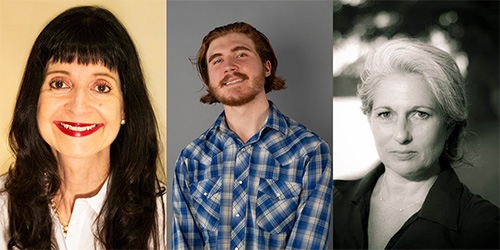
C. M. Rubin with Grant Lee Bomar and Darla Johnson
🎥 Watch A23a: What Are You Trying to Tell Us? now on Planet Classroom’s YouTube channel. This film is curated by Planet Classroom.
Related posts:
 The Global Search for Education: Climate Activist Drishya Pathak interviews Florian Graichen
 The Global Search for Education: Nathan Ward on Filming the Circus of Empowerment
 The Global Search for Education: Director Eshaan Mani Discusses Threads of Tradition
 The Global Search for Education: Crafting Connections at 30,000 Feet: Director Mark Kiefer Discusses By The Book
