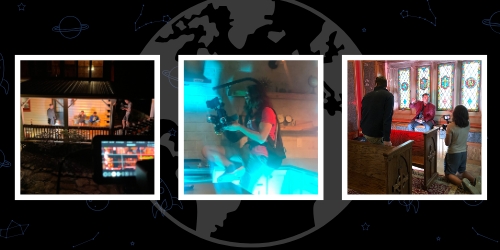
This month, American Gothic—a mind-bending short horror film by sibling writer-directors Grant and Dean Bomar—premieres on Planet Classroom’s YouTube Channel.
Shot as a surreal meditation on sibling memory, authorship, and the boundaries between creator and creation, the film stars Alan Boell, Bryson Bonta, Caitlin McPhail, and Danielle Carrozza. Below, the Bomar brothers discuss the philosophical ideas, improvisational process, and cinematic influences that shaped their award-winning debut.
Hey Guys, welcome back – what inspired you to explore sibling memory through surrealism?
There were several key inspirations going into this film. It is the culmination of hundreds of micro-influences, but the primary reason for the framing of memory is the philosophical debate between free will and fate. If someone were reduced to a character in a story, how would they know? Their world is built on memories—I often cite John Locke’s Memory Theory of Identity, as these characters’ conscious world is linked only to how much they remember and perceive their world, yet they find themselves forming a reality outside what they have known. We wanted to explore: What is a character, and does that illusion of self have the ability to take on a conscious form of its own? Does being a character mean one is reduced to a fated existence, or is it simply a façade created by free will, with the capacity to take on its own freedom? Further, we have an affinity for surrealism stylistically, but it also seemed that the best way to communicate the fracturing relationship between reality and characters was through abstraction, because that is how the process feels as reality and illusion mirror each other in increasingly bizarre and fragmentary ways. David Lynch is a massive influence. Alan’s use of the camera as a malevolent force is a nod to Robert Blake’s character in Lost Highway, and there are myriad small references and inspirations from Lynch’s filmography in both the concept and style of the film.
How did Alan Boell, Bryson Bonta, Caitlin McPhail, and Danielle Carrozza shape the film’s emotional core?
This is actually a really interesting element of American Gothic. We had worked with the cast for about two months leading up to production in improv rehearsals and shows at theatres such as Dad’s Garage and the Role Call Theatre in ATL. This was originally for a comedy called Just My Type, which unfortunately proved too ambitious to come to fruition. We pivoted to make this project in a much more intimate setting, and we really wanted a lot of authenticity in the characters and their performances. This carried through in many elements of the production, as we all stayed together in a cabin and were very close throughout the entirety of shooting. There’s a quote by Jean-Luc Godard: “Every film is a documentary of its actors,” and I think that happened here. It was a convergence of intentionally setting up the performers to put themselves into the characters; we shot without a script—entirely improvised—and worked on building real connections between the cast beforehand, as well as dealing with unintentional strains of the production. Because of the timeline of shooting and the setting, there was a real sense of being trapped by an artistic force, like the characters being imprisoned by the camera of their screenwriter father. In some ways it is too much to unpack, but looking back, the creation of the film and the interpersonal/emotional dynamics of the characters were mirrored in the film’s own production and vice versa. This theme of the recapitulation of creativity in the creator is something that has fascinated us so much that it is a foundational theme in our upcoming film Watching Katarina… No spoilers!
Within the story, how does authorship influence the power dynamic between the filmmaker and the characters?
The idea of authorship is central to the themes of the film. It is a parable of God, posing a world of characters who both have autonomy yet obey a creator who may or may not exist as a higher power. It also ties into how identity is formed, with individual authorship as a choice and as a by-product of the world around oneself. The contrast between autonomy and control—being an author and being at the whim of another—operates on many levels of American Gothic. For Alan, he is the author, but he has no control over his creations; for Caitlin, Bryson, and Danielle, they are trying to be authors of their own world. The question of what defines control and authorship is posed as a dichotomy between the past (one’s existence, the writer) and the present (what is perceived, the characters). In the final scene the characters stand around Alan; to them, the author is dead, yet in the scenes leading up to this moment, to Alan, the characters are dead. In this way, the choice of authorship and control is subjective, as both individual control and external control have the capacity to exist together and apart. Neither the characters’ nature—how they are written to be—nor their nurture—how they choose to be—is the only way to look at things; even in the release of control from the author, both realities exist.
How would you like audiences to interpret the film’s blur between memory and manipulation?
Reality is what we choose it to be. We have the capacity to let it be shaped by our environment and the ability to exercise individual freedom. Any situation mirrors itself on all levels, akin to characters as reflections of reality. American Gothic is, like the Godard quote, a documentary of its creation. Because of this, it is imbued with inversions and meta-concepts of the interplay between reality and illusion in creativity, identity, and more. It exists in a state of contrast—of improv and structure. The blurring between memory, reality, the tangible world, and that of creativity, artifice, and characters can symbolize whatever audiences want it to be. In reference to what it means, like what Caitlin says to Alan in the room of memory: Who made the decision—the creator or the audience?
That’s great—thank you both!
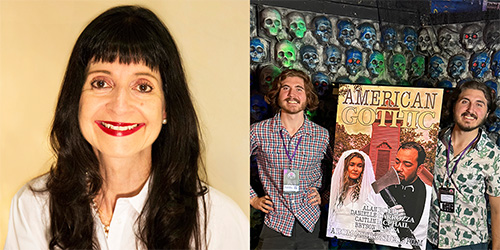
C. M. Rubin with Grant and Dean Bomar
Watch American Gothic now streaming on YouTube—curated by Planet Classroom.
Related posts:
 The Global Search for Education: Exploring Identity, Guilt, and Self-Reflection: An Interview with Grant Lee Bomar on Self Portraits
 American Gothic: A Haunting Exploration of Memory and Identity
 The Global Search for Education: Tomato Records – A Surreal Musical Journey with Grant Lee Bomar
 The Global Search for Education: How Gone Explores Teen Friendship, Loss, and Safety
