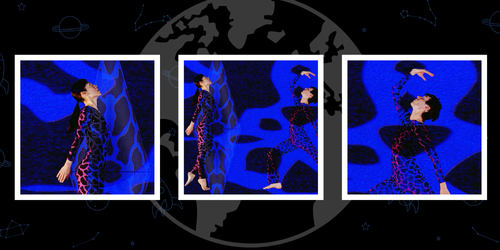
This month, audiences can experience Dystutopic, a kinetic dance-for-camera duet directed by Mimi Garrard, co-choreographed with Tim Bendernagel and Cynthia Koppe. Featuring Bendernagel and Koppe in performance, with cinematography and editing by Garrard, a score by João Castro Pinto, and costumes by Mindy Nelson, the work collides harmony and discord to invite viewers into creative tension. This film is curated by Planet Classroom.
Blending precise patterning with sudden rupture, Dystutopic transforms costume, music, and edit into shifting environments where utopia and dystopia meet—revealing how contrast can become choreography.
The Global Search for Education is honored to welcome back artist Mimi Garrard to reflect on the creative process behind Dystutopic.
Mimi, you handled direction, camera, and edit. What concrete editing rules (cut length, motif returns, repetitions) did you set to turn “contradiction” into a felt rhythm on screen?
I don’t follow any editing rules. I think that is why my work looks different from other filmmakers.
The choreography credits span you, Tim Bendernagel, and Cynthia Koppe. How did the three of you divide authorship—phrase-making vs. structuring—and what sequence best shows that collaboration?
When I work with the dancers, we work on material that can be incorporated into the three sections of the piece. The dancers know what section we are creating for. I usually give spatial directions so that the movement will be in focus. I also give directions about the quality of the movement. I also suggest if they work alone or together. We talk about the effect the lens is making on the movement. I allow the dancers to improvise with strict requirements and with a lot of freedom. We don’t work at all on the organization of the material. The organization of the material is done by me when the material is edited.
João Castro Pinto’s score crackles and thins. Did the picture drive the music edit or vice versa—and where did you intentionally let sound contradict movement?
The music is finished when I work with it, and I do not change it in any way. The music is always driving the action. However, we are not working with the music when we are creating movement. Therefore, there will always be interesting differences between the music and the movement.
Costumes by Mindy Nelson “line” the body. What palette/fabric tests informed those choices, and how did the wardrobe interact with lighting and camera to keep abstraction legible?
I choose the fabric for the costumes, and Mindy Nelson makes the costumes from the material I send her. In this piece, the material for the costumes was filmed, and I used it to create the background images. The costume material was constantly changing the space and the way the dancers were seen. The background could be simple or very complex and distorted.
It’s a magnificent work — thank you for sharing your thoughts with us Mimi!

C.M. Rubin with Mimi Garrard
🎥 Watch Dystutopic now on Planet Classroom’s YouTube channel.
This film is curated by Planet Classroom.
Related posts:
 The Global Search for Education: Climate Activist Wen Tian Interviews Hu Jiaojiao
 The Global Search for Education: Malibu Taetz on Animation and Anything Goes
 The Global Search for Education: Climate Activist Drishya Pathak interviews Florian Graichen
 The Global Search for Education: Nathan Ward on Filming the Circus of Empowerment
