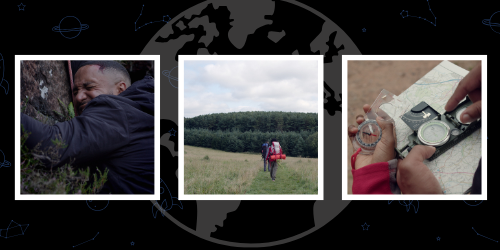
This month on Planet Classroom, audiences can watch Family Ties, a short film curated by KIDS FIRST! Film Festival exploring modern parenting, technology, and the bonds that hold families together.
After years indoors during the pandemic, outdoorsy dad Andrew takes his tech-addicted son Nicky on an overnight hike to reconnect. But when pushing to unplug backfires and they stray off-trail, disaster strikes—forcing Dad to rely on his son’s calm, know-how, and yes, his phone. Written, produced, and directed by Anderson West; starring Tre Grant-Barton and Sofian Francis; cinematography by Mark Kuczewski; music by Michael Tedstone. In eleven tight minutes, Family Ties balances tension and tenderness, asking what pride, love, and trust look like when it truly counts.
The Global Search for Education is pleased to welcome director Anderson West.
C. M. Rubin: Anderson welcome – tech as lifeline vs. distraction — when you wrote Family Ties, what moment convinced you that a phone could be both the “problem” and the “solution”? Did any real incident shape that turning point?
Anderson West: It wasn’t really a single turning point, but more of a gradual realisation that came from observing my son. I looked at the amount of media he was consuming on YouTube—I’m thinking of shows like Blippi and Baby Joy Joy, but Blippi in particular. I realised that a lot of this is educational content; it isn’t just “bad stuff.”
I was really impressed with the level of education he was getting. There was an episode where Blippi discussed how blueberries were harvested on a farm, then their process of being sorted and shipped to the supermarket. This was really solid educational content. It wasn’t just nonsense, like most of the popular kids’ shows we watched in the 90s, except for Sesame Street or PBS programmes, of course.
It made me start to think. It’s easy to have that old-school mentality of “Oh, lock off this YouTube, it’s all nonsense,” or the older generation’s view that “TV is rotting your brains.” And while a lot of it is nonsense, it opened my eyes. As parents, we don’t know everything, and here is this content that can actually help.
Yes, we’d all prefer if our kids were reading a book, but if a device is giving you the same knowledge you’d get from a book, just more passively, then that’s a benefit. It means we need to make intentional decisions about what our children are consuming. That was the real turning point: realising that while it’s easy to have a negative point of view, our children can actually learn from this. Technology can help improve our children’s lives if we, as parents, curate it properly and don’t just “carte blanche” call it bad.
C. M. Rubin: Working with young actors under pressure — how did you guide Tre Grant-Barton and Sofian Francis through the role reversal after the accident? Any rehearsals or on-set exercises that unlocked the father–son dynamic?
Anderson West: We had an excellent rehearsal a couple of weeks before filming, as well as read-throughs. I really wanted them to have a convincing father–son dynamic, but more than that, I just wanted them to feel at ease with each other. I thought that would be the most important thing.
They’re both very good actors. Tre was a very talented young performer. Having that rehearsal time allowed them to get comfortable with one another, which made the father–son dynamic believable.
Once we were on set, I trusted them a great deal and let them pace through the scenes, guiding them in those moments where it was necessary. Sofian was more experienced as an actor, and he would even help guide Tre in certain instances. They did a really good job, and that foundational work we did in rehearsal is what unlocked that dynamic.
C. M. Rubin: Crafting tension in the wild — can you walk us through one sequence where Mark Kuczewski’s cinematography and Michael Tedstone’s score worked together to build suspense without showing too much?
Anderson West: The climbing scene was where the tension racked up the most. That’s the moment when Sofian’s character, Andrew, truly understands that he’s in peril.
This is where the cinematography and score had to work together. Because they are in that cave-like cliff environment, Mark’s cinematography naturally began to take on a darker tone. Simultaneously, Michael Tedstone’s score became more intense. Up to that point, Michael’s score had been very well-paced and even upbeat. In that moment, the music shifts to reflect the reality of the tricky situation. The film’s tone takes a surprising turn.
Michael’s score was fantastic in achieving that, and Mark’s cinematography was really well done, complementing the scene perfectly. Even when you’re making the film, you’re never 100% sure how it will all come together. For me, it was just a case of finding that perfect balance in the edit.
C. M. Rubin: After-pandemic parenting & takeaway — what do you hope parents and teens debate on the ride home about unplugging, trust, and using tech well after watching those eleven minutes?
Anderson West: I hope the film unlocks the idea that we all need to be more open-minded as parents. Many of us take cues from how our parents parented, which was often very “hammer down,” “no, this is wrong,” with no discussion.
I hope this film encourages parents to have a discussion with their kids. Talk about what they’re watching and how they interact with technology. I know that for teenagers, social media can be a very damaging thing. As my son gets older, I’m increasingly aware that I need to have an open dialogue with him about using technology and what he consumes. Obviously, as a young person, he’s going to make his own choices, but as a parent, I have to be there having that open talk with him.
I also hope it reinforces that unplugging is important. As much as it’s great to have the world as connected as it is, we need to take that time to disconnect and actually talk with each other.
Great answers – Thank you Anderson!

C. M. Rubin with Anderson West
🎥 Watch Family Ties now on Planet Classroom’s YouTube channel.
This film is curated by the KIDS FIRST! Film Festival for Planet Classroom.
Related posts:
 The Global Search for Education: In Peace Boat, Young Activists Fight for Their Planet
 The Global Search for Education: Climate Activist Wen Tian Interviews Hu Jiaojiao
 The Global Search for Education: Malibu Taetz on Animation and Anything Goes
 The Global Search for Education: Climate Activist Drishya Pathak interviews Florian Graichen
