
This month, audiences can experience Peacock, a striking dance-for-camera short directed by multimedia pioneer Mimi Garrard, choreographed by Mimi Garrard with Tim Bendernagel and Cynthia Koppe. Featuring Bendernagel in solo performance, with costumes by Mindy Nelson and music by Tom Hamilton, the work extends Garrard’s award-winning exploration of digital techniques that transform movement on screen. Camera and editing are also by Garrard.
Blending choreographic precision with improvisation, Peacock transforms costumes, music, and editing into layered environments that echo the peacock’s iconic display—its pride, vulnerability, and search for attention.
The Global Search for Education is honored to welcome Mimi Garrard to reflect on the creative process behind Peacock.
Mimi, what sparked the visual concept for Peacock, and how did specific digital techniques shape both choreography and the final edit?
The visual concept was inspired by the costumes. Peacock is divided into three sections: in the first, the costume material is used as a black-and-white background; in the second, the imagery shifts into a sphere with a black circle at its center; and in the third, the dancers’ movements form the background within a cylinder. Each transformation creates a distinct environment for the choreography.
How did collaboration between camera, edit, and performance evolve—were there moments where the lens changed the movement you originally planned?
When I work with dancers, we create movement material without a predetermined structure—that structure comes later, through editing. The dancers, in this case Tim Bendernagel and Cynthia Koppe, are amazing collaborators. The camera setup stays the same, but the editing introduces new dimensions. I always experiment with editing, even when I have an idea of where to begin. That’s where the magic lies—the possibilities are endless.
In what ways did Tom Hamilton’s score and Mindy Nelson’s costumes influence pacing, palette, and gesture?
Tom’s music shaped the choreography from the start. It is abstract yet divided into three distinct sections: the first is delicate and dreamlike, the second is rapid yet light, and the third is dynamic and forceful. The choreography mirrors these qualities, with movements reflected in the cylinder background of the final section. Mindy’s costumes also inspired the backgrounds, linking visual and choreographic choices in an integrated way.
As a pioneer of dance for video, what new tools or workflows did you test here, and what should audiences look for on a second viewing?
In the first section, I used zooming in and out to create a dreamlike quality. For me, the most important thing is how everything fits together seamlessly—dance, costume, music, editing. Every project is an experiment, a chance to explore new editing ideas while learning from earlier works that approached dance differently. On a second viewing, I hope audiences notice how these elements interact to create a unified experience.
Mimi, thank you so much!

C.M. Rubin with Mimi Garrard
🎬 Peacock is now streaming on the Planet Classroom Network. This original film is curated by Planet Classroom.
Related posts:
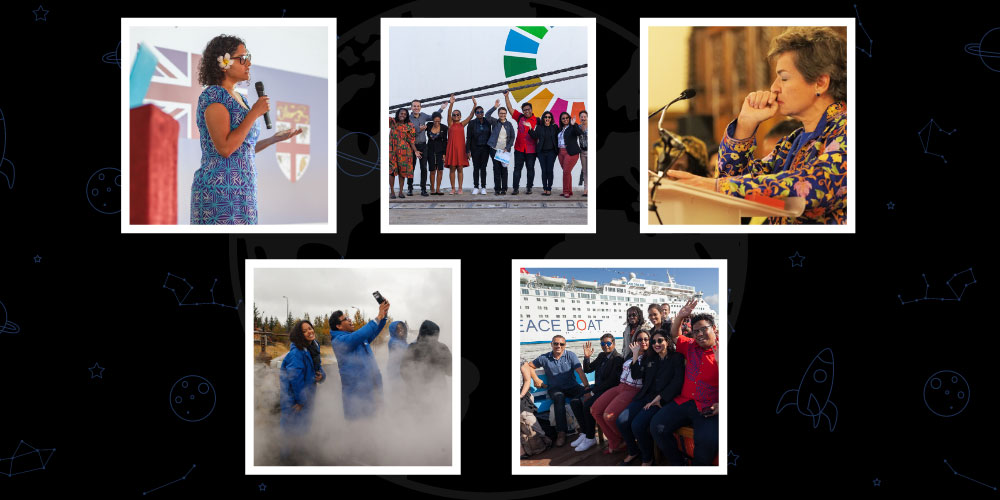 The Global Search for Education: In Peace Boat, Young Activists Fight for Their Planet
 The Global Search for Education: Climate Activist Wen Tian Interviews Hu Jiaojiao
 The Global Search for Education: Malibu Taetz on Animation and Anything Goes
 The Global Search for Education: Climate Activist Drishya Pathak interviews Florian Graichen
