
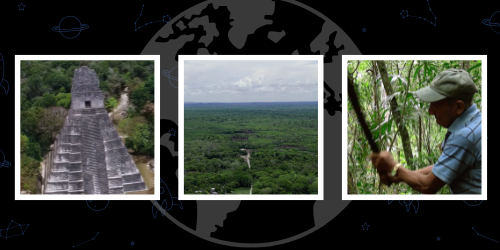
This month on Planet Classroom, audiences can watch The Giving Tree, a short film curated by Actuality Abroad for Planet Classroom that explores a living rainforest tradition in Guatemala through the eyes of the chicleros—the workers who harvest natural gum.
Directed and edited by Dominique Salalila, the film is set in Uaxactún, a small town in the Maya Biosphere where gum tapping has sustained families for generations. With cinematography by Ilse Anna Maria Meijer, Rex Giao, and Barbara Benitez-Curry, and sound by Alice McGenniss and BJ Price, this intimate short observes careful craft, community pride, and the bond with the forest that keeps roots alive.
The Global Search for Education is pleased to welcome Dominique Salalila.
C. M. Rubin: Dominique welcome – what single moment from filming still lives in your head—and what did it teach you about telling community stories responsibly?
Dominique Salalila: In general, I think about the town of Uaxactun quite frequently. I arrived in the Maya Biosphere with no expectations, and the more I learned about Uaxactun and the people who live and work there, the more my mind was blown. It is so full of historical and cultural legacies that have been protected by generations of the community. It is so fascinating and internationally relevant that I am surprised Uaxactun is not more famous. But at the same time, I think the remoteness of the community has helped preserve what makes it so special. For me, I was looking to present their story in a way that features what makes the community outstanding but also highlights for the audience the importance of preserving this way of life.
C. M. Rubin: How did you and producer Nikki Giant set consent and give-back with the chicleros and FCT—what did you offer the community in return for their time and trust?
Dominique Salalila: On top of being transparent about where we intended to use their likeness (in the films and on social media to promote the film projects), the filming crew intentionally tried to get to know each of our subjects. In our interviews, we asked questions that helped us understand their hopes and dreams coming out of participating in our project. Afterwards, we looked for the common goals each subject had to help us understand the hopes and dreams of the community as a whole. In the editing process, I had the wishes of our subjects in the back of my mind. For example, Don Emilio wishes to be able to connect to chicle buyers who would offer a high price for his product, while Don Erwin wants to raise awareness of the community’s efforts in (effectively) managing the rainforest’s resources in a sustainable way, in order to retain their rights to their home. While I’m not confident I can connect Don Emilio to chicle buyers, as a travel blogger, I am part of a travel community that seeks to explore the world in a responsible and respectful way. During the editing process, my travel community was the audience that I had in mind. My hope is that The Giving Tree can help boost tourism in the area, which in turn would help preserve Don Emilio and Don Erwin’s way of life.
C. M. Rubin: As director and editor, what rule guided your cuts to mirror gum harvesting’s patience—and where did you deliberately break that rule for impact?
Dominique Salalila: I was very mindful that the audience for The Giving Tree may not be bilingual. I may get a viewer who speaks only English or a viewer who speaks only Spanish. With this in mind, I wanted to use music to set the tone and be part of the story, regardless of language. Some of the final cuts were made to match the music.
C. M. Rubin: Which sequence best turns the rainforest into a character — and what, if anything, would you shoot differently if you returned today?
Dominique Salalila: The rainforest was the cradle of the Maya civilization. It was witness to the rise and fall of that civilization and the resurgence of their descendants in the 20th century to the present day. I think the varied tones and sequences throughout the film represent the rainforest’s character development through its different eras. I’m very proud of how the film and story turned out. It was very much shaped by the conversations and candid moments we had with each person who was featured. I don’t believe I would do anything differently—maybe have more off-camera interviews to get our subjects even more comfortable with telling their story? But I am overall proud of The Giving Tree.
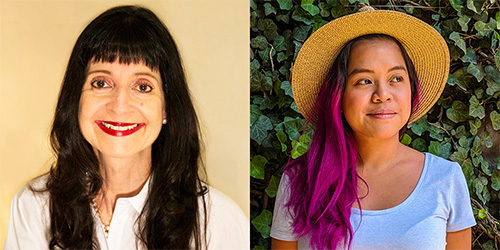
C. M. Rubin with Dominique Salalila
🎥 Watch The Giving Tree now on Planet Classroom’s YouTube channel. This film is curated by Planet Classroom for Planet Classroom.
Related posts:
 The Global Search for Education: In Peace Boat, Young Activists Fight for Their Planet
 The Global Search for Education: Climate Activist Wen Tian Interviews Hu Jiaojiao
 The Global Search for Education: Malibu Taetz on Animation and Anything Goes
 The Global Search for Education: Climate Activist Drishya Pathak interviews Florian Graichen
