
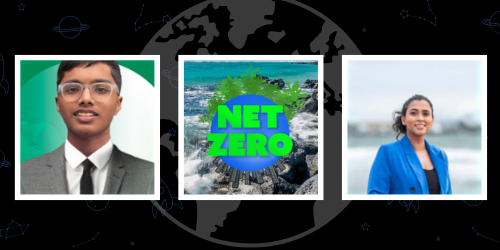
Monaaleekh B.K. Gowda in Conversation with Dr. Josheena Naggea
This month, global audiences can watch Net Zero Speaks with Dr. Josheena Naggea on the Planet Classroom Network. Curated by the Protect Our Planet (POP) Movement in association with Planet Classroom, the episode features an in-depth conversation between youth climate activist Monaaleekh B.K. Gowda and ocean sustainability leader Dr. Josheena Naggea.
Dr. Naggea is an André Hoffmann Fellow at the Stanford Center for Ocean Solutions and the World Economic Forum. Her work centers on blue justice, ocean governance, biodiversity conservation, and climate adaptation, with a focus on small-scale fisheries and coastal communities in the Western Indian Ocean — particularly Mauritius, her home country. She is also an IPBES Fellow contributing to the Transformative Change Assessment, examining pathways toward the 2050 Vision for Biodiversity.
In this powerful Net Zero episode, Dr. Naggea explains how climate action must move beyond global pledges and center equity for coastal communities whose livelihoods depend directly on the ocean. From disaster response during the Mauritius oil spill to grassroots biodiversity initiatives supported by the UNDP Small Grants Programme, she shares practical examples of how local leadership strengthens resilience.
Produced and edited by Sahana Garrett with art direction by Emily Brooks, the episode translates climate science, ocean governance, and gender equity into actionable strategies for achieving net-zero goals through community-driven change.
The Global Search for Education is pleased to welcome Monaaleekh B.K. Gowda
Monaaleekh, Why did you decide to interview Dr. Josheena Naggea?
I chose to interview Dr. Josheena Naggea because she represents the intersection of global climate leadership and local community action. Her work in blue justice and ocean governance shows how sustainability must include equity for small-scale fishers and coastal communities.
As an André Hoffmann Fellow at Stanford and the World Economic Forum, and an IPBES Fellow studying transformative change, she brings global expertise — but her work remains rooted in Mauritius. That balance between international policy and local impact aligns directly with Net Zero Speaks’ mission.
What surprised you most about the conversation?
I was struck by how grounded her approach is. Despite her global affiliations, she consistently emphasized community resilience.
Her reflections on the Mauritius oil spill — when thousands of volunteers mobilized to protect the coastline — demonstrated how powerful local action can be in times of crisis.
She also highlighted the inequities women in coastal communities face after disasters, connecting gender equity directly to climate adaptation and sustainable development.
What are your three key takeaways for the Net Zero audience?
1. Climate justice must include blue justice.
Ocean governance, small-scale fisheries, and coastal livelihoods must be central to climate policy. Sustainability without equity is incomplete.
2. Community-led solutions build real resilience.
From grassroots biodiversity projects to volunteer mobilization during environmental crises, local leadership strengthens adaptation and recovery.
3. Youth leadership matters.
Young people are not observers of climate change — they are accountability partners. Sustainable development must move from local action to global policy, and youth voices must remain central.
Throughout the episode, Dr. Naggea reinforces a core message: sustainable development must connect people to place. Climate resilience is not only about emissions reduction — it is about protecting livelihoods, advancing gender equity, strengthening biodiversity, and empowering coastal communities to lead.
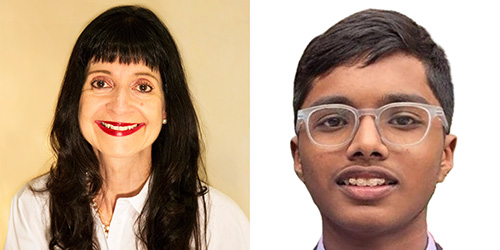
Monaaleekh B.K. Gowda and C.M (Cathy) Rubin
Net Zero Speaks with Dr. Josheena Naggea is now streaming on the Planet Classroom Network YouTube Channel
The Net Zero Speaks series is curated by Planet Classroom in association with the Protect Our Planet (POP) Movement.
Related posts:
 The Global Search for Education: In Peace Boat, Young Activists Fight for Their Planet
 The Global Search for Education: Climate Activist Wen Tian Interviews Hu Jiaojiao
 The Global Search for Education: Malibu Taetz on Animation and Anything Goes
 The Global Search for Education: Climate Activist Drishya Pathak interviews Florian Graichen
