This month on Planet Classroom’s YouTube channel, audiences can watch Pedal It Forward, a documentary curated for the Planet Classroom Network by Actuality Abroad.
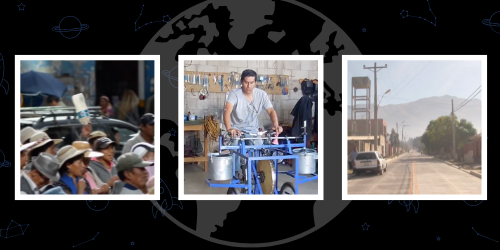
Directed by J. Cole Gerke and produced by Catjia Rehkamp, with cinematography by Ewelina Kolakowska and editing by Brian Walsh, the film follows communitarian innovator Freddy Candia in Cochabamba, Bolivia, where nearly 64% of the population lives below the poverty line. Determined to break cycles of poverty, pollution, and inequality, Freddy transforms discarded bicycles into pedal-powered bici-máquinas that generate renewable energy for soap production and hot showers.
Through intimate, on-the-ground storytelling, Pedal It Forward highlights how grassroots clean-energy innovation can create sustainable economic opportunity. More than a portrait of invention, the film explores how local leadership, renewable technology, and community resilience intersect to drive systemic change in developing regions.
The Global Search for Education is pleased to welcome director J. Cole Gerke.
C. M. Rubin: What inspired you to follow Freddy’s journey in Bolivia?
J. Cole Gerke: What inspired us most was Freddy’s selflessness and genuine commitment to leaving the world better than he found it. He has an exceptional engineering mind and could easily work for a large company, but instead he chooses to build eco-friendly inventions that benefit his community for generations.
Freddy also has a bright, charismatic personality that doesn’t immediately come through in a serious documentary tone. Because innovators in developing communities often lack the resources to market their work or secure funding, we wanted to give him a platform. Our hope is that the film connects him with people who can help bring his renewable energy projects to scale.
C. M. Rubin: What emotions defined the filming process?
J. Cole Gerke: The dominant emotion was motivation. Freddy thinks big and operates with zero fear of failure. Our crew had to match that energy.
Above his workbench there’s a sign that reads, “You Can Sleep When You’re Dead,” and he truly lives by it. Watching his work ethic and presence in each moment grounded all of us. It reminded us that meaningful change requires full commitment.
C. M. Rubin: Are bicycle-powered inventions the only path toward solving challenges in developing countries?
J. Cole Gerke: First, it’s important to use the term “developing countries” rather than “third-world.”
Freddy’s bike-powered machines are just one example. He also built a solar oven, an ecological bathroom that converts waste into fertilizer, and was developing a water purification system while we were filming. What matters is not the bicycle itself — it’s the principle: renewable, low-waste, locally accessible solutions can be transformative.
C. M. Rubin: What is your biggest personal takeaway from Freddy’s journey?
J. Cole Gerke: Anything worth doing is worth overdoing. Half measures don’t change the world.
Pedal It Forward demonstrates that renewable energy innovation does not have to begin with massive infrastructure. Sometimes it starts with a discarded bicycle, a determined engineer, and a belief that sustainable development can be built from the ground up.

C. M. (Cathy) Rubin with J. Cole Gerke
🎥 Watch Pedal It Forward on Planet Classroom Network’s YouTube channel.
This film is curated by Actuality Abroad for Planet Classroom.