
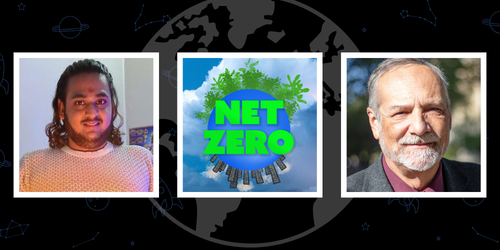
Pranav Kumar Gahadwal in Conversation with John Nielsen-Gammon
This month, global audiences can watch Net Zero Speaks on the Planet Classroom Network, featuring a timely conversation between climate host Pranav Kumar Gahadwal and Texas State Climatologist John Nielsen-Gammon. The series is curated by Planet Classroom in association with the Protect Our Planet Movement.
John Nielsen-Gammon, Texas State Climatologist and Director of the Southern Regional Climate Center, turns complex climate science into practical strategies for managing extreme weather—from floods and hurricanes to drought and rising heat.
In this Net Zero Speaks episode, he explains how climate change is intensifying these extremes, introducing the “7% moisture rule” to show why storms are becoming heavier even as dry periods worsen. His insights reveal that these events are not isolated, but part of an interconnected system reshaping how cities must prepare.
Focused and accessible, the conversation connects climate science to real-world action—from infrastructure and building design to early warning systems—highlighting how data-driven decisions can build stronger, more resilient communities.
The Global Search for Education is pleased to welcome Pranav Kumar Gahadwal.
C. M. Rubin: Pranav, why did you choose to interview Professor John Nielsen-Gammon?
Pranav Kumar Gahadwal:
I decided to interview Professor John Nielsen-Gammon because he represents the kind of climate scientist who turns complex atmospheric data into practical, decision-ready knowledge.
As the Texas State Climatologist and Director of the Southern Regional Climate Center, he works at the frontline of some of the most extreme weather patterns in the world—from flash floods and hurricanes to long-term droughts and extreme heat. What makes his perspective especially valuable is his ability to explain why these extremes are happening in simple, actionable terms, and how communities can respond in real time.
For Net Zero Speaks, I wanted to explore climate change not just as a global trend, but as something that is reshaping infrastructure, cities, and daily survival systems. Professor Nielsen-Gammon was the ideal guest because he connects climate science directly to drainage systems, building codes, disaster preparedness, and public safety planning—the exact spaces where climate risk becomes a real impact.
C. M. Rubin: What surprised you most about this interview?
Pranav Kumar Gahadwal:
What surprised me most was how clearly he showed that climate extremes are not isolated events, but part of a connected system of heat, water, and atmospheric energy.
He explained how Texas can swing from drought to devastating floods because a warmer atmosphere holds significantly more moisture, making rainfall events much more intense while also worsening dry periods. What stood out was how he consistently framed these shifts not as abstract climate theory, but as engineering and planning challenges—things cities can actually design for.
I was also struck by his emphasis on measurement and real-time data systems like TexMesonet, which turn climate monitoring into an operational tool rather than just academic research. It made climate science feel immediate, grounded, and deeply tied to public decision-making.
C. M. Rubin: Finally, Pranav, what are your three key takeaways for the Net Zero audience?
Pranav Kumar Gahadwal:
1. Extreme weather is intensifying because the atmosphere itself is changing.
One of the clearest insights was the physical link between warming temperatures and extreme rainfall. A warmer atmosphere holds more moisture, which means storms are becoming heavier and more concentrated—even as droughts intensify in between. This “drought-to-deluge” pattern is becoming the new normal in places like Texas.
2. Climate resilience must be built into infrastructure, not added after disasters.
Professor Nielsen-Gammon emphasized that adaptation is fundamentally about planning systems differently—drainage, flood control, housing design, and coastal standards. Cities need to update infrastructure using current climate realities, not historical averages. In other words, resilience is no longer optional; it has to be embedded in how we design communities.
3. Data-driven systems are the backbone of preparedness.
A major takeaway was the importance of real-time monitoring and early warning systems. These tools allow states to track heat, drought, flooding, and wildfire risks as they evolve, enabling faster and more targeted responses. The key message was that better data doesn’t just improve understanding—it directly improves lives saved, damage reduced, and response time shortened.
Thank you Pranav!

C. M. Rubin and Pranav Kumar Gahadwal
WATCH: Net Zero Speaks with John Nielsen-Gammon which is now streaming on the Planet Classroom Network YouTube Channel.
The Net Zero Speaks series is curated by Planet Classroom in association with the Protect Our Planet Movement.
Related posts:
 The Global Search for Education: Climate Activist Drishya Pathak interviews Florian Graichen
 The Global Search for Education: Nathan Ward on Filming the Circus of Empowerment
 The Global Search for Education: Director Eshaan Mani Discusses Threads of Tradition
 The Global Search for Education: Crafting Connections at 30,000 Feet: Director Mark Kiefer Discusses By The Book
